
Simple, Professional Invoicing for Clinicians
Built for healthcare professionals and independent clinicians who bill by the hour or day.
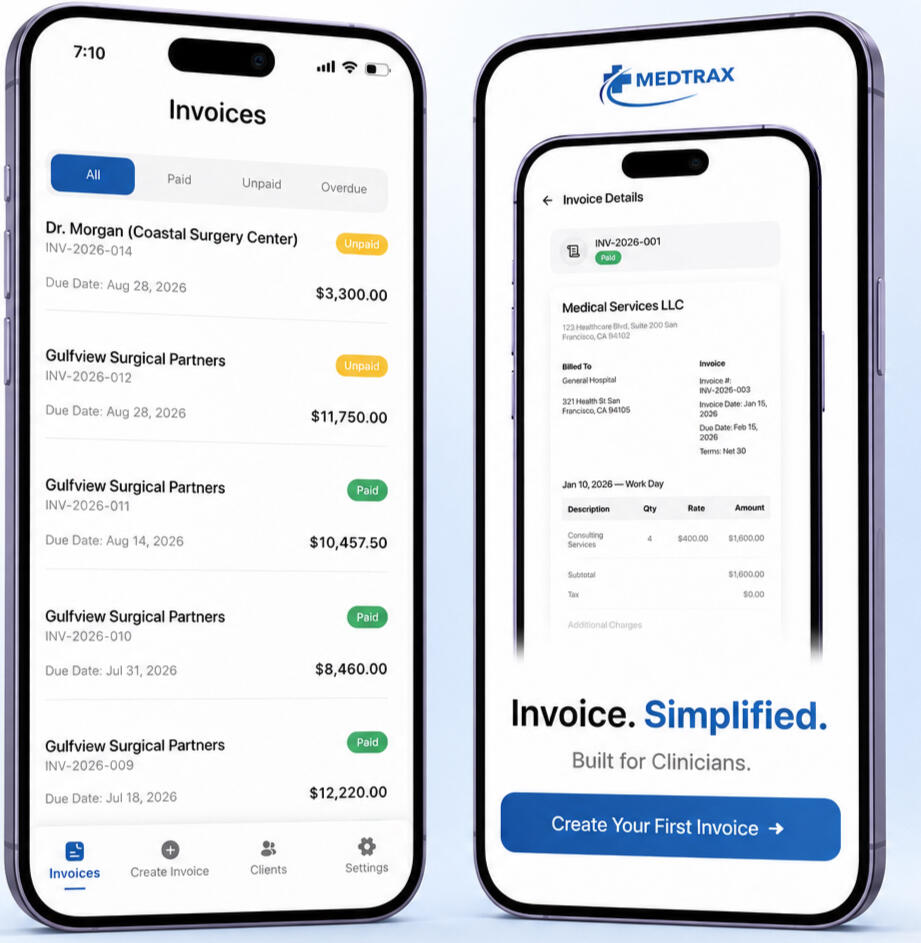
Hourly & Daily Billing
Mileage, Bonus & Per Diem Tracking
Track Unpaid, Paid & Overdue Invoices

Download MedTrax Today
Available now on the App Store
Founding Pricing: $4.99 / month
or $49.99/Year
No patient data · No coding · No insurance billing
Insights for independent clinicians
Practical invoicing tips for healthcare providers who bill hourly or daily.
The 7 Invoicing Mistakes That Cost Independent Clinicians Thousands
The most common billing errors clinicians make -and how to prevent them.
How to Invoice Multiple Facilities Without Losing Track
A simple, practical approach to invoicing when your work spans multiple locations, rates, and schedules.
Why Spreadsheets Break Down for Locum and Contract Billing
Spreadsheets feel easy at first—but here’s why they eventually create more work than they save.
Frequently Asked Questions
The 7 Invoicing Mistakes That Cost Independent Clinicians Thousands
The most common billing errors independent clinicians make—and how to prevent them before they cost you real money.
If you’re an independent clinician—locum, contract-based, or 1099—your invoice is your paycheck.Yet invoicing is one of the most common places money quietly leaks out of otherwise successful practices. Not because clinicians are careless, but because most billing tools weren’t designed for people who work across multiple facilities, bill by the hour or day, and manage everything themselves.Here are seven invoicing mistakes we see over and over again—and how to avoid them.1. Relying on memory instead of real-time tracking
Waiting until the end of the month to reconstruct your work invites errors. Details fade, shifts blur together, and extra hours get missed. Even one forgotten half-day per month adds up over a year.
Fix: Track work the same day it happens.2. Mixing multiple facilities on one invoice
Combining several locations into a single invoice creates confusion for billing departments and slows payment.
Fix: Keep invoices separated by facility and date range.3. Forgetting mileage, lodging, or per diem
Travel-related compensation is often agreed upon but not always invoiced. If it’s not listed, it won’t be paid.
Fix: Track expenses as you go so nothing slips through.4. Using spreadsheets that quietly break over time
Spreadsheets work until formulas break, versions multiply, and paid vs unpaid becomes unclear.
Fix: Use a system built for recurring invoicing workflows.5. Inconsistent invoice formatting
Different layouts, wording, or missing details slow processing and delay payment.
Fix: Use a consistent, professional invoice format every time.6. Not tracking overdue invoices
Without visibility, unpaid invoices sit longer than they should.
Fix: Always know what’s sent, paid, and overdue.7. Treating invoicing as an afterthought instead of a system
Invoicing is revenue operations. When it’s ad hoc, money gets delayed or lost.
Fix: Build a simple, repeatable invoicing workflow.These issues are exactly why MedTrax exists—clean, professional invoicing for independent clinicians who bill hourly or daily, without insurance billing or unnecessary complexity.
How to Invoice Multiple Facilities Without Losing Track
A simple, practical approach to invoicing when your work spans multiple locations, rates, and schedules.
If you’re an independent clinician, chances are you don’t work in just one place.Multiple facilities, different schedules, and varying billing expectations are normal—but they’re also where invoicing starts to break down.The core issue is that your work isn’t linear. Trying to force it into a single invoice or spreadsheet creates confusion and delays.Here’s a cleaner way to manage it.Why multi-facility invoicing gets messy
Dates blur together. Rates vary. Facilities have different pay cycles. When everything is lumped together, it becomes harder to track what’s owed and what’s been paid.The most common mistake
Trying to simplify too much. Fewer invoices may feel efficient, but clarity is far more valuable than consolidation.A better approach:
One facility per invoice
Always separate invoices by location.Tight date ranges
Invoice weekly, per assignment, or per pay period.Clear rate breakdowns
Separate hourly vs daily work, overtime or call, and travel-related expenses.Track status in real time
You should always know what’s been sent, paid, or overdue.
This approach reduces questions, speeds up payment, and removes mental overhead.It’s also exactly how MedTrax is designed to work—structured, facility-based invoicing that matches how independent clinicians actually practice.
Why Spreadsheets Break Down for Locum and Contract Billing
Spreadsheets feel easy at first—but here's why they eventually create more work than they save.
Spreadsheets are often the first invoicing tool independent clinicians use. They’re familiar, flexible, and easy to start.But spreadsheets were built for math—not for ongoing billing workflows.Over time, cracks start to show.Where spreadsheets usually fail
Loss of visibility
As tabs and months pile up, it becomes harder to see what’s been paid and what’s overdue.Version confusion
Multiple copies lead to uncertainty about which invoice was sent or updated.Silent errors
Broken formulas or copied rows don’t always announce themselves.Expenses get scattered
Mileage, lodging, and per diem live in notes, emails, or memory—and don’t always make it onto the invoice.
Most clinicians hit a tipping point where invoicing takes longer than it should or confidence in the numbers starts to slip.That’s when spreadsheets stop being helpful.A purpose-built system keeps everything organized by facility and date, tracks invoice status, and removes the need for constant manual upkeep.MedTrax was designed to replace spreadsheet chaos with clean, consistent invoicing—without insurance workflows or patient data.
Terms and Conditions
These Terms and Conditions govern your access to and use of MedTrax and its invoice and billing features.
Acceptance of TermsBy downloading, accessing, or using MedTrax, you agree to be bound by these Terms and Conditions. If you do not agree to these terms, you should not use MedTrax.Use of the AppMedTrax is an invoice and billing app that allows users to create and manage invoices, add line items with quantity, rate, and totals, include reimbursements such as mileage, per diem, and bonus payments, manage profile and business details, generate and share or export PDF invoices, and track invoice statuses such as paid, unpaid, and overdue.You may use MedTrax only for lawful purposes and in accordance with these Terms and Conditions.User Accounts and ResponsibilitiesYou are responsible for maintaining the security of your account, device access, and any credentials associated with MedTrax. You are also responsible for all activity that occurs through your use of the app.You agree to provide accurate information and to keep your profile, business details, invoice content, and related records current where appropriate.Invoice Accuracy and User ContentMedTrax provides tools to help users prepare, organize, and share invoice-related materials, but the accuracy, completeness, legality, and appropriateness of all invoice content and client information remain the user’s responsibility.You are solely responsible for verifying line items, rates, quantities, reimbursement entries, totals, invoice status, client details, and any exported or shared documents created through MedTrax.Acceptable UseYou agree not to misuse MedTrax or use it in any way that could harm the app, its users, or related systems. This includes attempting to interfere with the operation of the app, gain unauthorized access, distribute harmful code, infringe the rights of others, or use MedTrax for unlawful, fraudulent, or deceptive purposes.Intellectual PropertyMedTrax, including its software, design, branding, text, graphics, and related materials, is protected by applicable intellectual property laws. Except for the limited right to use the app under these Terms and Conditions, no ownership rights are transferred to you.Third-Party ServicesMedTrax does not rely on third-party services or integrations for its core functionality. Invoice creation, invoice management, reimbursement tracking, status tracking, and PDF generation are provided within the app itself.If MedTrax introduces any third-party services in a future release, these Terms and Conditions may be updated to reflect that change.DisclaimersMedTrax is provided on an “as is” and “as available” basis. To the fullest extent permitted by law, MedTrax disclaims warranties of any kind, whether express or implied, including implied warranties of merchantability, fitness for a particular purpose, non-infringement, accuracy, and uninterrupted availability.MedTrax does not provide legal, tax, accounting, or professional financial advice. Users should obtain appropriate professional guidance where needed.Limitation of LiabilityTo the fullest extent permitted by law, MedTrax and its affiliates, licensors, service providers, and related parties will not be liable for any indirect, incidental, special, consequential, exemplary, or punitive damages, or for any loss of profits, revenue, data, business, goodwill, or other intangible losses arising out of or related to your use of MedTrax.TerminationMedTrax may suspend, restrict, or terminate access to the app at any time if necessary to protect the app, comply with legal obligations, address security concerns, or respond to violations of these Terms and Conditions.Changes to TermsMedTrax may update these Terms and Conditions from time to time. Continued use of the app after updated terms are posted constitutes acceptance of the revised terms.Contact UsIf you have questions about these Terms and Conditions, please contact [email protected].
Privacy Policy
This Privacy Policy explains how MedTrax handles information when you use the MedTrax invoice and billing app.
IntroductionMedTrax is an invoice and billing app that helps users create, manage, and share professional invoices. This Privacy Policy explains what information may be collected through the app, how that information is used, and the choices available to users.By using MedTrax, you acknowledge that you have read and understood this Privacy Policy.Information We CollectMedTrax may collect information that you provide directly while using the app and information that is generated through normal app operation.
Profile and business information, such as your name, business name, billing details, and other information you choose to enter.
Invoice information, including invoice numbers, dates, line items, quantities, rates, totals, notes, and invoice status details.
Client information, including names, contact details, and billing information that you add to manage invoicing.
Reimbursement and payment entries, such as mileage, per diem, bonus payments, and other adjustments entered by you.
Technical and usage information, such as device-related information, app performance information, and diagnostic data where needed to support reliability and security.
How We Use InformationMedTrax uses information to provide the core functions of the app, including creating and managing invoices, calculating totals, tracking invoice status, maintaining business and client details, and generating PDF invoices for export or sharing.Information may also be used to maintain the performance and security of the app, troubleshoot issues, improve features, and respond to support-related inquiries.Invoice and Client DataMedTrax allows users to store and manage invoice content and client records. Invoice details, line items, reimbursement entries, payment status information, and client details are entered and controlled by the user.You are responsible for ensuring that the invoice and client data you enter into MedTrax is accurate, appropriate, and compliant with any laws or requirements that apply to your use of the app.Data Storage and SecurityMedTrax uses reasonable technical and organizational safeguards to help protect information stored or processed through the app. These safeguards may include secure storage practices, protected transmission where applicable, and platform-level device protections.Although MedTrax takes reasonable steps to protect information, no method of electronic storage or transmission can be guaranteed to be completely secure. Users should also protect their own devices, credentials, and exported documents.Sharing of InformationMedTrax does not sell personal information. Information may be shared only where necessary to operate the app, support essential technical services, comply with legal obligations, protect rights or security, or complete actions that you choose to perform, such as exporting or sharing invoice PDFs.Third-Party ServicesMedTrax does not use third-party services to provide its core invoice and billing functionality. The app is designed to operate without external service providers for features such as invoice creation, invoice management, reimbursement entry, status tracking, and PDF generation.If this changes in a future version of MedTrax, this Privacy Policy will be updated accordingly.Data RetentionInformation is retained for as long as reasonably necessary to provide app functionality, maintain records, support user-requested actions, comply with legal obligations, resolve disputes, and protect legitimate business or operational interests.Deleted information may remain in backups or archived copies for a limited period where reasonably necessary.Your Rights and ChoicesDepending on applicable law and the way you use MedTrax, you may have choices regarding your information, including the ability to review, update, export, or delete information stored through the app.You may also manage device permissions and control when and how invoice files or other materials are shared with third parties.Children’s PrivacyMedTrax is intended for general invoicing and billing use and is not directed to children under the age of 13. MedTrax is not designed to knowingly collect personal information from children under 13.Changes to This PolicyMedTrax may update this Privacy Policy from time to time to reflect changes in app features, legal requirements, or business practices. When changes are made, the updated version will be posted with a revised Last Updated date.Contact UsIf you have questions about this Privacy Policy or the privacy practices of MedTrax, please contact [email protected].